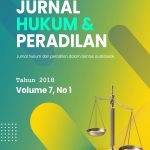
- Cempaka Putih, DKI Jakarta Pusat 10510



Jurnal Tahun 2019
Volume 8, No 3
1. Asean Regional Arbitration Board: An Alternative Dispute Resolution In The Asean Region Within The Framework Of The Asean Economic Community
Abstract.
Transactions among ASEAN member countries are increasingly open with the release of the ASEAN Economic Community (MEA). Entrepreneurs in ASEAN countries are expected to make more transactions with their business partners in the Southeast Asian region. Increasing business relations in the ASEAN region will in part affect the increase in disputes among ASEAN entrepreneurs. This study aims to provide an idea regarding the establishment of the ASEAN Regional Arbitration Agency as an effort to overcome the issue of the execution of arbitration decisions by utilizing regional unification. This research is descriptive analytical using a normative juridical approach. The results of the study show that ASEAN should be a place for resolving international commercial disputes, especially on business transactions carried out in the ASEAN member countries, if ASEAN has a regional arbitration forum, the procedure for resolving business disputes in this region will be simpler, more effective and easier. Legal system barriers can also be overcome if there are procedures that are jointly recognized.
2. Charging Director Of Company With Personal Bankruptcy For Company Mismanagement
Abstract.
This study aims to examine the theories, regulations, and practices at the commercial court in Indonesia regarding the possibility of charging director of limited liability companies (LLC, Perseroan Terbatas(PT)) with personal bankruptcy as a form of personal liability due to mismanagement causing the company to go bankrupt. This is an interesting issue to study because, in general, the rights and obligations of the company, and specifically LLC in this article, are separated from the rights and obligations of the directors. Therefore, the company’s liability cannot be requested upon its directors’ personal liability. Nonetheless, this general principle is revocable if the director makes an error which causes the company to go bankrupt. This study uses the normative (doctrinal) legal research method with statute approach, conceptual approach, and cases approach. The study results revealed that directors could be asked for personal liability if they create problems which lead to a company going bankrupt. The director’s liability comes in the form of the obligation to file bankruptcy for the director him/herself. In this study, several cases were found that punished the director with the director’s personal bankruptcy, like in the case of personal bankruptcy of director PT QSAR and in the case personal bankruptcy of director of PT CHK.
3. Dimension Of Whistleblowing System: Urgensity Of Legislation Strengthening
Abstract.
Eradication of corruption in Indonesia is still the main agenda of the government in building good governance. One method to expose corruption is to use a whistleblower role that can help find the criminal mode of corruption. Whistleblower mechanism is divided into three main dimensions: Human, Structure and Process. But in practice whistleblower reporters in corruption cases in Indonesia have not received maximum legal protection. In Indonesia the normative regulation governing pursuant to Law No.13 of 2006 concerning Witness and Victim Protection as well as Supreme Court Circular Letter (SEMA) No.4 Year 2011 on Treatment of Criminal Reporting and Witness of Actors Cooperation The results show that from three dimensions of whistleblower system still does not yet have binding legislation. Whistleblower reporters only accept lightening relief. Specific whistleblower legislation is urgent. In legislation, at least, it should be in accordance with Whistleblower’s protection.
4. The Protection Of Religious Freedom Of Sunda Wiwitan Believers
Abstract.
Sunda Wiwitan as a religion had existed prior to the other, more well known religions in Indonesia, but is currently isn’t recognized as an official religion by Act No.1/PNPS/1965. The state, as opposed to guaranteeing the freedom of belief and its practice, instead imposes restrictions on religion in this particular case, leaving the believers of Sunda Wiwitan feeling abandoned and as outcasts. As a result, many violations and discriminations are experienced by adherents of Sunda Wiwitan. One example of such discrimination is the “whiting-out” of the “religion” column in ID Cards. The result of this discrimination is difficulty in accessing civil documents, in addition to verbal violence from certain parts of the society who assume the Sunda Wiwitan belief as heretic.
5.Criminal Code Bill Article 414 And Sex Education In Indonesia
Abstract.
Sex education in Indonesia still taboos to talk in an educational context; however, sexual abuse, free sex, and abortion are increasing more and more. This situation more likely will get in an emergency when criminal code bill article 414 about showing contraception tools to children is applied because it is considered cut off sexual education teaching and against HIV/AIDS and family planning campaign. This article focuses on analyzing criminal code bill article 414 toward sex education in Indonesia and discussing possible solutions for including sex education in the school curriculum. Several critics addressed in criminal code article 414, and several solutions were given in this article for including sex education in the Indonesian curriculum. There is some limitation occurred toward this article, especially, the literature which addressed this issue is limited. In addition, it seems the experts are not discussing about this issue regularly.
6. “Bystander Effect” In Cases Of Corruption In Corporate, Bureaucratic And Political Orders
Abstract.
E-KTP Corruption is an organized crime that occurs in Indonesia. The corruption that has been established is to form an organized network due to the phenomenon “baystander effect” where it is a phenomenon of social psychology due to the loss of a sense of virginity to act to do something on an incident that Characterized by the interdependent nature of each other which eventually nothing moves one. This research aims to prove the existence of a matter of silence because it is triggered by personal interests or “self-interest” of the persons involved until difficult to control by the State apparatus. This method of research refers to the reference of legislation, information submitted by the media, statements from politicians and bureaucracy officials, court decisions and also reference books. The results of the study showed that the corruption that ensnares the bureaucracy officials and the politicians in fact has also dragged corporations. Participating in the case of the persons in corruption cases of intertwining creates a crime that is organized in such a way to harm the country and cause millions of people to be injured in the sleep. When they feel benefited over this corruption case then they choose silence, this is the phenomenon called “baystander effect” thus complicating the investigation in dismantling this corruption case.
7. Restorative Justice In Juvenile Justice To Formulate Integrated Child Criminal Court
Abstract.
The purpose of this article is to formulate the concept of restorative justice which balanced to protect between child offenders and the victims through the diversion (Victim-offender oriented). This goal will be realized through normative research (legal research) based on Restorative Justice concept. In Law Number 11 of 2012 concerning the Child Criminal Justice System the process (SPPA Law), its prioritizes the Diversion Process (Settlement outside the court) carried out through a Restorative Justice approach. Article 5 paragraph (2) of the SPPA Law states Restorative Justice is the settlement of criminal cases by involving perpetrators, victims, families of perpetrators /victims, and other related parties to jointly to find a fair solution by emphasizing recovery and not based on revenge. Empirical conditions show that balanced legal protection between criminal offenders and victims has not implemented. Evaluation of Law Number 11 of 2012 is needed to formulating the Integrated Child Criminal Court.
8. Lawsuit In Administrative Court After Administrative Proceedings Based On Perma No. 6 Of 2018
Abstract.
The enactment of Law No. 30 of 2014 concerning Government Administration very much changes the paradigm of the proceedings in the State Administrative Court. One of the fundamental things is about administrative proceedings as pre-litigation proceedings. Under Article 75 of Law No. 30 of 2014 concerning Government Administration, citizens who feel disadvantaged by a Government’s Decision or Action can file an administrative proceedings, and then file a lawsuit in the Administrative Court. Regarding this regulation, two interpretations arise regarding the obligation of administrative proceedings as pre-litigation proceedings. One party argues that the administrative proceedings as pre-litigation proceedings must be carried out before filing a lawsuit in the Court, and the other argues this is not mandatory. For a period of four years, the interpretation of the obligation of administrative proceedings as a pre-litigation proceedings in Law No. 30 of 2014 concerning Government Administration is floating in the realm of discourse. It was only on December 4th, 2018 that the Supreme Court issued a Supreme Court Regulation (PERMA) No. 6 of 2018 concerning Guidelines for Resolving Disputes Regarding Government Administration After Administrative Proceedings, finally the Supreme Court dictates that administrative proceedings as a pre-litigation proceedings is a must. However, the PERMA does not regulate fundamental things regarding lawsuit after administrative proceedings, namely, who will be seated as the defendant, and what is the object of the lawsuit. In addition, there are also a number of things that needed to be reviewed regarding the arrangements in the PERMA, such as regarding the deadline for a lawsuit in the Court.
Audiobook Jurnal
1. Asean Regional Arbitration Board: An Alternative ...
2. Charging Director Of Company With Personal Bankruptcy ...
3. Dimension Of Whistleblowing System: Urgensity ...
4. The Protection Of Religious Freedom Of Sunda Wiwitan Believers
5. Criminal Code Bill Article 414 And Sex Education In Indonesia
6. “Bystander Effect” In Cases Of Corruption In Corporate ...
7.Restorative Justice In Juvenile Justice To Formulate Integrated...
8. Lawsuit In Administrative Court After Administrative ...